 EN
EN  LT
LT
Your cart
There are no more items in your cart


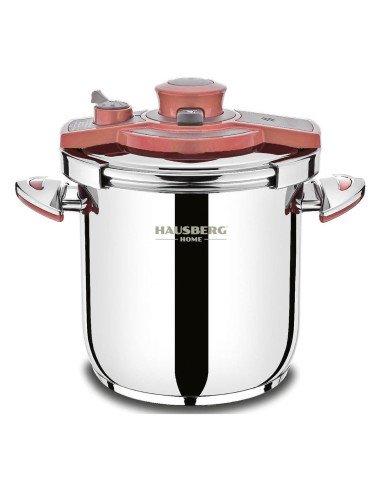
Hausberg HB-H 309 Pressure Cooker 9 L, 18/10 Stainless Steel, 0.70-1.40 bar
Last items in stock
€109.00
Tax included
Dispatched within 1 business day.
9 L pressure cooker in 18/10 (304) stainless steel with a 0.80 mm wall and a thermo-capsule base that suits every hob, induction included. Working pressure 0.70–1.40 bar at up to 120 °C; the cooking valve has three settings (0.50 / 0.60 / 0.70 bar), a safety valve opens at 1.40 bar and the safety lock keeps the lid closed while there is pressure inside. Food cooks in about a third of the usual time.
The Hausberg HB-H 309 is a 9 L pressure cooker for preparing larger meals quickly. The body and the lid are made of 18/10 (304) stainless steel with a 0.80 mm wall, and the thermo-capsule sandwich base spreads the heat evenly and works on every heat source, induction included. Under pressure food cooks in about one third of the usual time – roughly 10 minutes instead of 30 – which saves energy and preserves the flavour and the nutrients.
| Specification | Value |
|---|---|
| Type | Pressure cooker |
| Capacity | 9 L |
| Working pressure | 0.70–1.40 bar |
| Temperature | up to 120 °C |
| Cooking valve settings | 1 – 0.50 bar, 2 – 0.60 bar, 3 – 0.70 bar |
| Material | Stainless steel 18/10 (304), body and lid |
| Wall thickness | 0.80 mm |
| Base | Thermo-capsule sandwich base |
| Compatible hobs | All types, induction included |
| Handles | Heat-resistant side handles |
| Safety | Three-position cooking valve, safety valve at 1.40 bar, full release through body and lid at 2.0 bar, air valve safety lock |
| EAN | 6423808060337 |
| Country of origin | China |
| Packaging dimensions and weight | 30 × 34 × 30 cm, 3.98 kg (packaging, not the cooker) |
Safety system
- The cooking valve has three settings: 1 – 0.50 bar, 2 – 0.60 bar, 3 – 0.70 bar. Excess pressure escapes through the valve.
- If the cooking valve should become blocked, the safety valve opens at 1.40 bar and releases the excess pressure.
- If both the cooking valve and the safety valve are blocked, at 2.0 bar the pressure is released through the body and the lid.
- Air valve (safety lock): while the clamps are open the air valve is open; pressing the closing button shuts it. As long as there is pressure inside, the lid cannot be opened.
Before first use
Take the silicone gasket out of the lid, rinse it with boiling water, dry it and put it back in the correct position. The gasket must sit evenly, with no gap between it and the stainless steel lid – otherwise the required pressure cannot build up. Check the position of the gasket before every use.
How to use
- Opening the lid. Turn the cooking valve to the pressure-release position, press the opening button under the lid handle with your thumb – the lock releases on both sides – and lift the lid.
- Filling. Pour at least one glass of water into the cooker. Never use the pressure cooker without water – it must contain at least 1/3 of its volume in liquid. Do not fill it above 2/3 of its capacity (the limit is marked inside). Foods that swell – rice, dried pulses – may fill no more than half of it. For foods that foam (artichokes, peas, rice) add a spoonful of butter or oil before cooking.
- Closing the lid. The cooking valve must be in the pressure-release position and the clamps released. Put the lid on, press its top with one hand and press the closing button with the thumb of the other. Make sure the clamps have locked and do not touch the body.
- Cooking. Place the cooker on the hob at the highest setting. The flame must not reach beyond the base and the hotplate must not be larger than the base. The cooking valve must be fully open. After a while you will hear a hissing sound and see steam escaping – at that moment turn the valve to setting 1, 2 or 3 according to the food. Cooking time starts from that moment. Do not touch the valve while cooking; it releases the excess pressure by itself.
- Opening after cooking. Switch the hob off and wait about 5 minutes for the pressure to drop. Gently turn the cooking valve to the release position and wait until all the steam has escaped. Only then open the lid, keeping a safe distance. Never force the pressure cooker open.
- Fast cooling. If you need to open it sooner, hold the cooker under running water for about 1 minute after switching the hob off, then turn the valve to the release position.
A large amount of hot steam can escape from the cooking valve and hit the face or other parts of the body. A high-pitched sound during a rapid pressure drop is normal. The lid can only be opened once the steam has been fully released. Do not choose fast pressure release for vegetables, grains or foods that foam.
Important — safety
- Never leave the pressure cooker unattended and keep it out of the reach of children.
- Never use the pressure cooker in an oven and never for any purpose other than the one it was designed for.
- Move the cooker very carefully, do not touch hot surfaces, lift it by the handles only and use oven gloves if needed.
- Make sure the cooker is properly closed before placing it on the heat source.
- Never force it open and never open it before you are sure the internal pressure has been fully released.
- When cooking meat with skin, such as sausages, pierce it with a sharp knife before cooking – do not pierce the skin afterwards, as it may burst and scald.
- With juicy foods and dough-based dishes, shake the cooker gently before opening the lid so that the food does not spill.
- Before every use check that the valves work properly and freely.
- Never deep-fry in the pressure cooker under pressure.
- Never modify the safety system. Use only spare parts recommended by the manufacturer; the body and the lid must be from the same manufacturer.
Cleaning and care
- The body can be washed by hand or in a dishwasher like any other stainless steel pot. Do not use metal brushes, abrasives or bleach – they damage the surface.
- Wash the lid only by hand, with warm water and washing-up liquid. THE LID AND THE SILICONE GASKET MUST NOT GO INTO THE DISHWASHER.
- Clean the cooking valve after every use: unscrew the nut under the lid by hand, remove the o-ring carefully so as not to lose it, clean the plastic part of the valve and reassemble everything in the same order, paying attention to the direction.
- The silicone gasket should be removed after every use and washed by hand with warm water, a sponge and soap, then dried. With daily use the gasket should be replaced with an original one every year.
- Stubborn stains: put the juice of half a lemon with 2 cups of water into the cooker, boil under pressure for 5 minutes, take it off the hob, let it cool and rinse with warm water. Salt and limescale marks can be removed with concentrated vinegar or lemon juice; add salt only once the water is boiling.
- Storage: store the cooker empty, clean and completely dry, with the lid turned upside down on the body – this protects the silicone gasket.
Troubleshooting
| Symptom | What to do |
|---|---|
| The cooker will not close | Seat the gasket properly in the lid; open the clamps fully on both sides; turn the cooking valve to the pressure-release position and try again |
| Too much steam escapes from the valve while cooking | The heat is too high – reduce it; the valve may be dirty – release the pressure, unscrew and clean it; replace a faulty valve with an original one |
| Steam or drops of water leak around the lid | The valve is dirty or blocked – let the cooker cool completely and clean it; there may be too little water – add at least one glass; check the gasket for damage and that the o-ring under the valve is in place |
| The cooker will not open | The pressure has not been released – the safety lock is active, wait a moment; if it cools slowly a vacuum may form – turn the valve to the release position; if the valve is blocked let the cooker cool completely. Never force the lid |
Reference cooking times
| Food | Min. | Food | Min. |
|---|---|---|---|
| Artichokes | 4 | Chicken breast | 12–18 |
| Fresh beans | 4 | Chopped chicken | 10–12 |
| Broccoli | 4 | Pork with bone | 25–30 |
| Cabbage (1/2) | 10 | Beef | 25–35 |
| Carrots (whole) | 5 | Fillet | 10–15 |
| Carrots (sliced) | 3 | Fish fillet | 5–8 |
| Cauliflower | 3 | Shrimp | 4–8 |
| Sweetcorn | 6 | White rice | 6 |
| Potatoes (cubed) | 6 | Chicken with rice | 10 |
| Potatoes (1/2) | 8 | Dried beans | 14–18 |
Add 1.5 cups of water for vegetables. For meat and fish use half the amount of water stated in the recipe. For rice add a spoonful of butter or oil to reduce foaming.
Compliance and disposal
- The pressure cooker is not an electrical appliance, so the WEEE directive and CE marking under the low-voltage or EMC directives do not apply to it. Parts in contact with food are covered by Regulation (EC) 1935/2004 and the silicone and plastic parts by Regulation (EU) 10/2011; Regulation (EU) 2023/988 on general product safety and the domestic pressure cooker standard EN 12778 also apply.
- Take the cooker to a metal waste collection point at the end of its life. Sort the packaging: cardboard and paper to paper collection, film to plastic collection.
Manufacturer and importer
- Manufacturer: Bervin Dis Ticaret Ltd. Sti., European Free Zone, Karamehmet Mah., Avrasya Bulvari No:15, Ergene / Tekirdag, Turkey, tel. +90 282 691 10 09, info@hausberg.com.tr
- Importer / responsible person in the EU: BSC Vilnius, UAB, Kareiviu g. 19, Vilnius 09133, Lithuania. Tel. +370 637 09990. www.fit2.shop, info@fit2.shop
No reviews
Tap to zoom